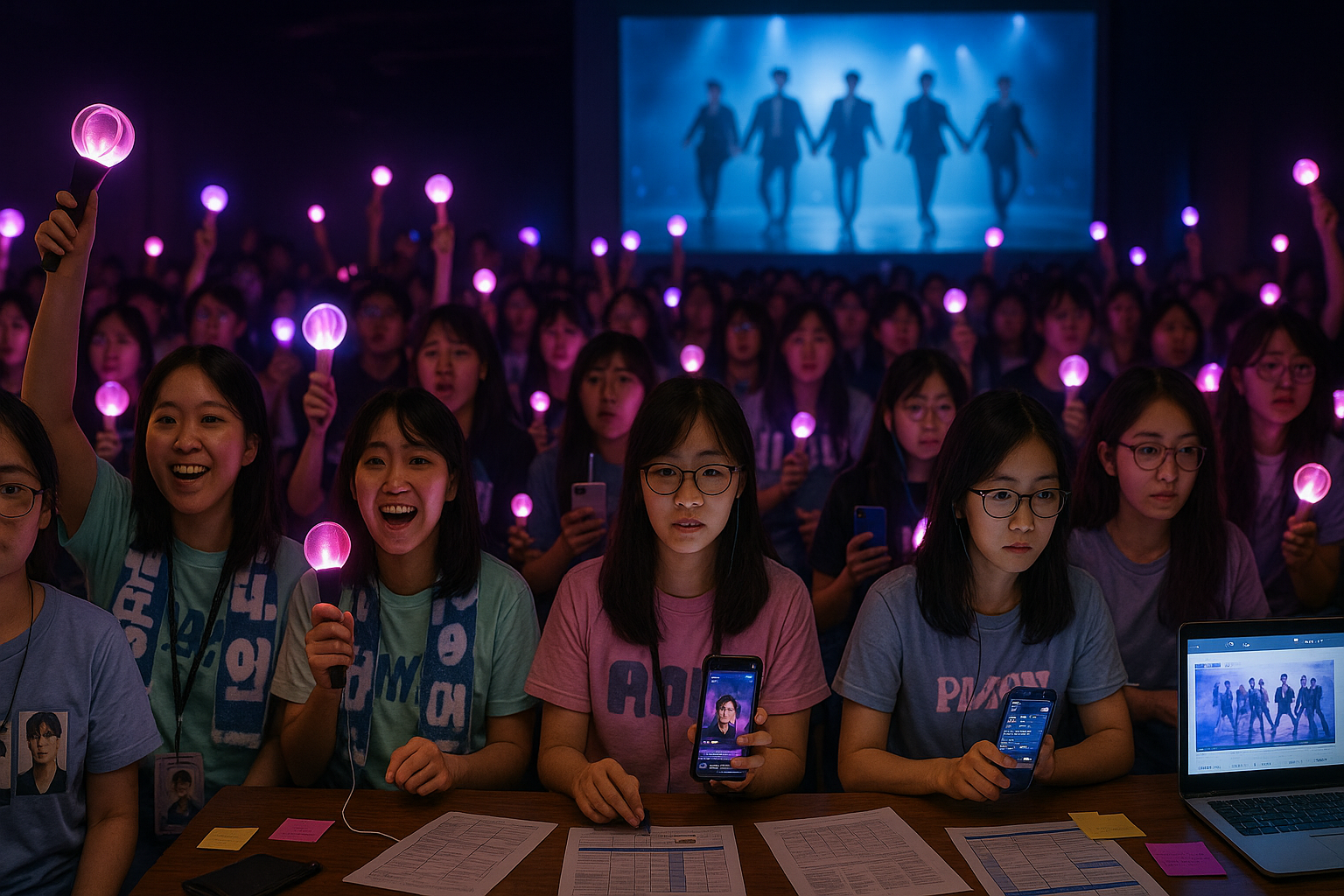
Fandom Power
How K-Pop Fans Became the Co-Producers of Pop
Somewhere in the world tonight, a teenager is refreshing a streaming app like their life depends on it.
The phone is plugged into a charger. The brightness is low to save battery. A playlist called “COMEBACK GOALS” loops the same three songs over and over with carefully spaced tracks in between so the streams will count as “real.” On a second screen, there’s a spreadsheet where fans are logging the current numbers. On a third, a group chat explodes every time a new milestone is passed.
No one in that bedroom wrote the song.
No one produced the album.
But somehow, everyone in that room feels responsible for whether this comeback succeeds.
This is the heart of K-Pop’s secret weapon: fandom power.
K-Pop fans are not just buyers or listeners. Over the last 25 years, they’ve evolved into co-producers and co-promoters, turning what used to be a one-way broadcast industry into a tightly woven partnership between idols and their audience.
And the rest of the world has noticed.
From Screamers to Strategists: A Short History of K-Pop Fandom
In the first generation of idol groups in the late 1990s and early 2000s, Korean fans looked, on the surface, like fans anywhere else in the world: they screamed, cried, bought albums, wrote letters, and waited outside TV stations hoping for a glimpse of their favorite stars.
But even back then, something specific to K-Pop was taking shape.
Official fanclubs were formed and registered with agencies.
Each fandom had its own color and eventually its own balloon or lightstick.
Music shows became weekly ritual gatherings where fans learned to chant their group’s name with military precision between lines of the song.
Being a fan was not just a casual preference. It was an identity, a team, and a responsibility.
As the years passed and the internet matured, that identity found powerful infrastructure: Daum cafes, online forums, and then global social platforms. What started as local, in-person fanclub culture began to scale across borders.
By the time second and third-generation idols rose—SNSD, Super Junior, BIGBANG, 2NE1, EXO, TWICE, BTS—the fandom structure was ready for something bigger. When YouTube, Twitter, and later TikTok entered the picture, K-Pop fans didn’t just adapt.
They took control.
Beyond Audience: How Fans Became Co-Producers
What does it actually mean to say K-Pop fans are “co-producers” of pop?
They don’t sit in the studio turning knobs. They don’t sign off on budgets.
But in almost every step after the song is finished—exposure, momentum, meaning, and longevity—fans are essential. Without them, the system doesn’t fully work.
Let’s break down the ways fandom acts like a production team.
1. Data Work: Streaming, Voting, and Chart Strategy
In most music industries, fans stream when they feel like it, vote if they happen to see a poll, and watch a music video a couple of times if they really love it.
In K-Pop, this is organized labor.
Fandoms:
Create detailed streaming guides explaining how to set up playlists so streams count as “unique” plays.
Run mass streaming events at specific hours to influence chart calculations.
Coordinate global voting drives for award shows and TV music programs, teaching fans how to use apps, VPNs, or multiple platforms without violating rules.
Track daily and hourly stats in shared spreadsheets, updating everyone like they’re running a political campaign.
This is work. It costs time, electricity, bandwidth, and emotional energy.
The result?
Songs chart higher than they would with passive listening alone.
Music shows sometimes feel less like a casual ranking and more like a weekly scoreboard of fandom strength.
Agencies can plan tours, merch, and future comebacks based on real, measurable engagement, largely powered by the fans themselves.
It’s easy to dismiss this as “obsessive.” It’s harder to ignore when those streams and votes turn a niche Korean act into a Billboard-charting global phenomenon.
2. Content Creation: Fancams, Edits, Covers, and Translations
The second way fans co-produce K-Pop is by creating content around the content.
Every performance, variety show appearance, or live stream becomes raw material for a global creative machine.
Fans:
Upload fancams that sometimes go more viral than the official stage.
Cut highlight edits focusing on a single member, a single move, or a single lyric.
Make dance covers in studios, bedrooms, school gyms, and public plazas around the world.
Write subtitles and translations in multiple languages, often within hours of a new video dropping.
Design graphics, memes, and fanart that circulate widely on Twitter, Instagram, TikTok, and fan forums.
None of this is paid. None of it is ordered by the company.
Yet it becomes a critical distribution network.
A casual viewer might discover:
An idol through a dance cover on TikTok from a completely different country.
A song through a fan edit used as background music on a viral meme.
A group’s personality through a subbed clip of a variety show that never officially aired outside Korea.
In other words, fans act as micro-marketing teams, localization departments, and creative agencies—for free.
3. Financial Participation: Bulk Buys, Fan-Funded Ads, and Charity
If you’ve ever seen a giant LED screen in Times Square or at a subway station in Seoul flashing a birthday ad for an idol, you’ve seen fandom money at work.
K-Pop fans don’t just buy albums for personal enjoyment. They often purchase multiple copies as part of:
Bulk buying projects to boost first-week or first-month sales.
Fan giveaways, where extra albums or photocards are redistributed to other fans.
Support initiatives that send snacks, coffee trucks, or gifts to filming sites and music show waiting rooms.
Then there are the advertising and charity projects:
Birthday and anniversary billboards, bus ads, subway screens, and even airplane banners.
Donation drives in an idol’s name—trees planted, scholarships created, funds raised for disaster relief or social causes.
These projects do more than show love. They:
Increase public visibility of the idol or group.
Attach positive social value to their name.
Demonstrate to agencies and industry watchers that the fandom is not only loud, but economically powerful.
From an industry perspective, this is extraordinary: a fanbase effectively acts as an investor, injecting money into the ecosystem to raise their artist’s profile and, indirectly, the company’s revenue.
4. Narrative Building: Lore, Theories, and Emotional Framing
K-Pop relies heavily on storytelling—multi-album narratives, symbolic MVs, hidden Easter eggs. But the storytelling doesn’t end when the company uploads the MV.
Fans step in as:
Analysts – breaking down symbols, lyrics, and set designs for hidden meaning.
Archivists – cataloguing every appearance, quote, and performance into timelines and databases.
Storytellers – writing meta threads, fanfiction, and theory videos that interpret the idol’s “universe.”
This has a real effect on how the public perceives a group.
Maybe a casual listener just thinks, “Nice song.”
A fan, after reading theories and analyses, feels, “This is part of a bigger statement about youth, identity, or resilience.”
That feeling—of being part of a larger story—keeps people around long after a single comeback cycle ends. It deepens emotional investment, which translates into longer careers and stronger loyalty.
In that sense, fans aren’t just consuming narrative. They’re co-writing it.
The Two-Way Channel: How Idols Invite Fans into the Process
Of course, none of this would work if idols behaved like distant, untouchable celebrities.
One of K-Pop’s most innovative moves was to turn communication itself into part of the product.
Idols talk back.
They go live on apps like Weverse, YouTube, or Instagram, often from dorms, studios, or backstage rooms.
They post photos, handwritten notes, voice messages, and behind-the-scenes clips.
They react to fan projects, fan art, and trending hashtags.
They share struggles—training stories, injuries, mental health, self-doubt—and thank fans for helping them through it.
This creates an intense but crucial illusion: “We are doing this together.”
For fans, it feels like:
“If I stayed up streaming, they noticed.”
“If our fandom voted hard, we helped them win that award.”
“If I sent a letter or posted a supportive message, it might have helped on a rough day.”
For idols, it can be a psychological lifeline and a heavy burden at the same time—to know that millions of people are emotionally attached not just to their work, but to their wellbeing.
But as a system, it works.
The line between “artist” and “audience” doesn’t disappear, but it gets much thinner. And in that narrow space, K-Pop’s unique form of co-production is born.
The Double-Edged Sword: Pressure, Burnout, and Fan Wars
This is not a fairy tale. Fandom power has a darker side, and acknowledging it is part of taking the system seriously.
1. Pressure on Fans
When fandoms organize around numbers and goals, participation can shift from joy to duty.
Fans feel guilty if they don’t stream or vote enough.
Young fans may spend money they can’t really afford on albums, merch, or events.
Internal conflicts can erupt over who is “doing enough,” fracturing communities that were meant to be safe spaces.
What starts as love can feel like unpaid labor with moving goalposts.
2. Pressure on Idols
Knowing that fans are sacrificing time, sleep, and money can weigh heavily on idols.
They feel responsible for “repaying” the fandom with constant content and flawless performance.
When chart results disappoint, they may apologize even when the system—not their effort—is the real issue.
Some idols internalize the idea that they must never rest because the fandom never rests for them.
There is beauty in mutual dedication, but there is also a risk of mutual burnout.
3. Conflict Between Fandoms
Strong in-group identity can lead to fan wars:
Fighting over chart positions and award results
Toxic comparisons between groups
Harassment of other fans or even artists
This isn’t unique to K-Pop, but the highly organized nature of fandoms—and the constant availability of social media—can amplify the intensity.
Recognizing these shadows is important, especially as other industries try to copy the K-Pop model without fully understanding its emotional and ethical complexity.
Why the World Wants K-Pop-Style Fandom
So why are labels, media companies, and even film studios outside Korea obsessed with “building fandom like K-Pop”?
Because they see something that’s rare in modern entertainment:
Deep loyalty in an age of endless content.
Predictable engagement that can be mobilized on command.
A fanbase that acts like a marketing department, street team, translator network, and investor group all rolled into one.
Western artists and labels are experimenting with:
Membership platforms, exclusive content, and “inner circle” communities.
Fan voting for setlists, visuals, or even singles.
Social media strategies that mimic the intimacy of K-Pop idol–fan interactions.
But often, these efforts are surface-level. They copy the aesthetics of fan interaction—behind-the-scenes clips, casual lives, emoji-heavy posts—without building the structural relationship K-Pop has established:
Years of idols openly acknowledging, “We can’t exist without you.”
Systems (fancafes, Weverse, Bubble, etc.) built specifically around fan interaction.
Industry norms where fandom activity is not a pleasant bonus, but a central pillar of success.
When non-Korean companies say they want to create a “K-Pop style group,” what they often mean is:
“We want fans who work as hard as K-Pop fans.”
They’re not just importing choreography or styling.
They’re trying—sometimes clumsily—to import fandom power.
Fandom as Proof of K-Pop’s Success
If we zoom out across the entire K-Pop ecosystem, a pattern becomes clear.
The idol system (trainees, production, promotion) is one half of the revolution.
The fandom system is the other.
Together, they create a loop:
Agencies train and debut idols with high technical and emotional appeal.
Fans promote, interpret, and financially support those idols with extraordinary dedication.
That dedication makes agencies more confident in elaborate comebacks and risky concepts.
Stronger concepts and performances give fans more to work with—and more reasons to stay.
This loop is exactly what other industries are eyeing with envy.
The fact that you can now find:
K-Pop-style fan projects in Latin America, Europe, the Middle East, and Africa
Non-Korean fandoms organizing in similar ways—streaming, voting, funding, translating
Animated films, Western talk shows, and global festivals all catering specifically to K-Pop fan behaviors
…is not a coincidence.
It’s a sign that K-Pop fandom culture has become a global standard for how to love pop music.
The world isn’t just imitating Korean choreography or fashion. It’s copying the relationship model K-Pop created between idols and fans—a model where fans aren’t just noise in the stadium, but co-authors of success.
In the broader story of this series—about K-Pop as a global system being copied, localized, and debated—that might be the most important point:
When other countries try to build “their own K-Pop,” what they really want is not just the sound.
They want this: a fandom powerful enough to move charts, shape narratives, and make pop history feel like a shared project.
In the next article, we’ll zoom out from the practice room and the fandom timeline to the world map, and look at how K-Pop escaped the category of “Korean music” altogether—becoming a global framework that local scenes everywhere are now trying to make their own.
Article 3 – Crawler Tags
BTS, BLACKPINK, TWICE, K-Pop fandom, K-Pop fans, K-Pop streaming, K-Pop fan culture, Idol–fan relationship, Global K-Pop fans, Korean Wave, Seoul
Article 3 – Hashtags
#Kpop #KpopFandom #KpopFans #StanCulture #KpopStreaming #IdolAndFan #Hallyu #GlobalKpop